One of the great joys of having a highly cited paper is that I usually get one or two notifications every week of new studies that cite it from Google Scholar. This notifies me of papers that use my work that sometimes fall well outside of my usual radar. It is very interesting to discover who is reading my paper! I try to read every paper that cites my work and I learn a lot.
This week, there is a paper by Anderson et al, who studied a Mississippian (early Carboniferous) aged carbonate succession in Iowa in the United States to deduce the magnitude of the Late Paleozoic glaciation. This particular paper was investigating in the so-called Kinderhookian-Osagean Boundary Excursion (KOBE), a global carbon isotope shift that happened betwee 354.1 and 353 million years ago. Carbon isotopes are one way to investigate changes to the environment in the past.
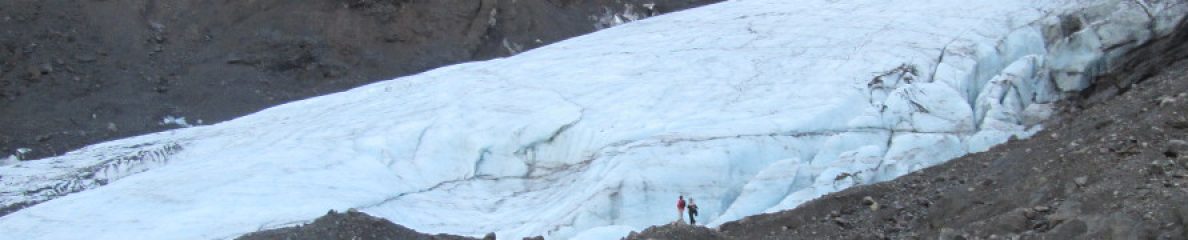
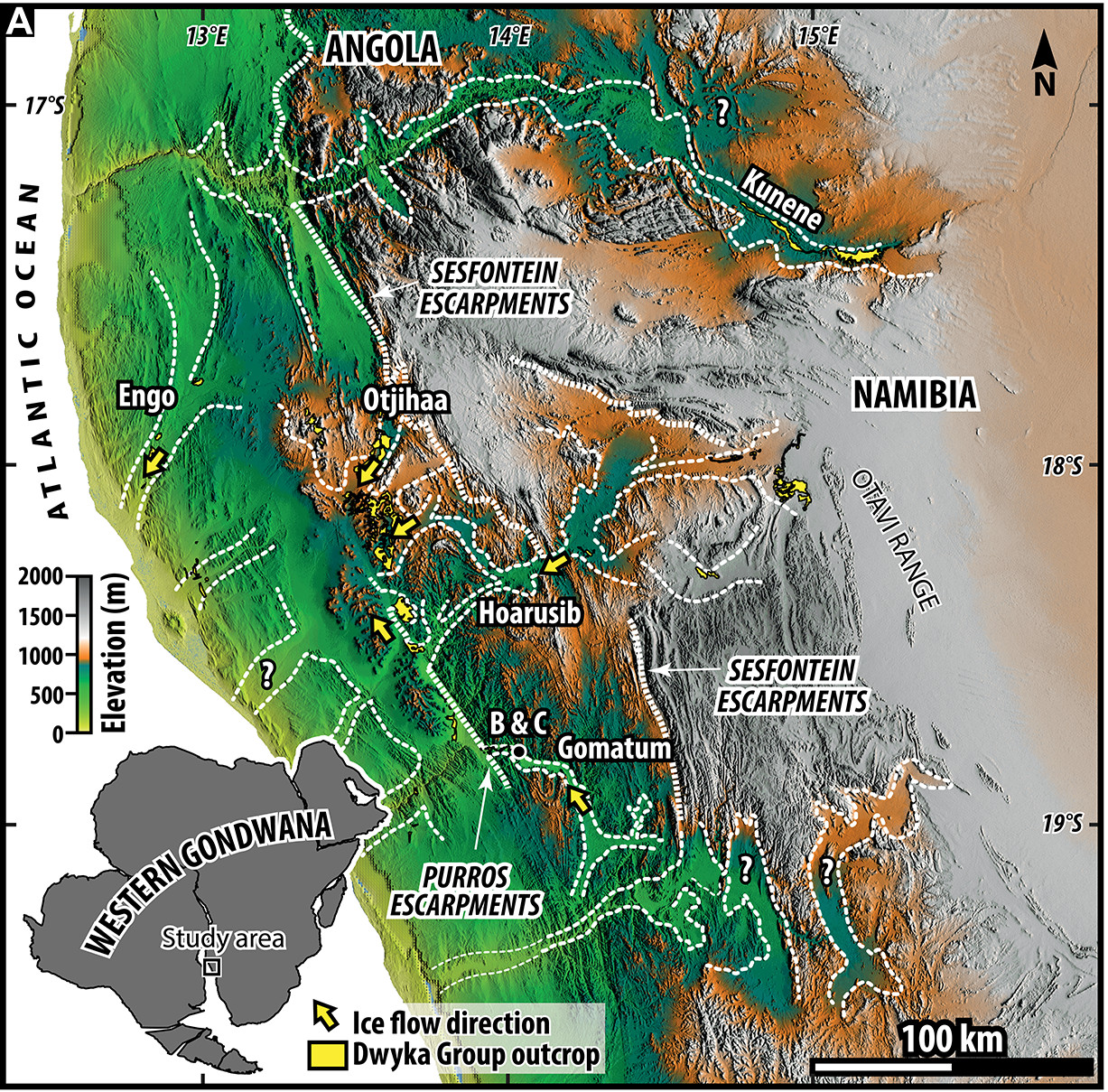
The Late Paleozoic Ice Age was the last major glaciation prior to the current ice age. At that time, many of the continents were merged together into a supercontinent called Gondwana. What is now Africa, South America and Australia were centered on the South Pole. Evidence of this glaciation can be found from the remains of fjords in Namibia.
In the study from Anderson et al, they investigated carbonates from a borehole in Iowa. During the early Mississippian, Iowa was a shallow sea in the tropics.

The KOBE carbon isotope excursion is a large change in the carbon isotopes. This, there are two isotopes of carbon, 12C and 13C. The isotopes behave slightly differently in chemical reactions, and changes in the amount of these isotopes in carbonate rocks that are produced in the ocean will tell you things about the climate and environment. It is measured as a relative change in 13C, denoted as δ¹³C. The δ¹³C increased during the KOBE excursion by about 7 permille (parts per thousand). There apparently is not complete agreement on the precise cause or causes of this excursion, but it is possibly linked to a large amount of organic carbon (that is, plants) being stored geologically. There is a reason why the geological period is known as the Carboniferous – there is a lot of coal in North America from this time.
In this particular study, they wanted to link changes in the KOBE carbon isotope excursion with the temperature of the ocean. They used a technique known as “clumped isotopes”, also known as Δ47. A carbonate rock is made up of minerals such as calcite and dolomite, which have carbon and oxygen in their chemical structure. The two main isotopes of oxygen are 16O and 18O, and the main isotopes of carbon are 12C and 13C. The larger numbers indicate that the atoms have more neutrons, and are therefore heavier. To analyze the relative amount of isotopes, the carbonate rock is broken down chemically, and the released CO2 is investigated. The 47 refers to the fact that they investigate the amount of CO2 molecules that have one atom of 18O, one atom of 16O, and one atom of 13C (18+16+13=47). This is special because most carbon atoms are 12C and most oxygen atoms are 16O, so the sum is usually 44. The amount of molecules with both 18O and 13C atoms in a carbonate is dependent on temperature, so it can be used to estimate the temperature of the water the carbonate rock formed in. The higher the Δ47 value, the colder the water.
Anderson et al did this, and found that the increase in the δ¹³C started before the water temperatures started to decrease. As I discussed in episode 6 of the Raised Beaches Podcast, the atmospheric CO2 values during the Late Paleozoic ice age were comparable to what they are now. This result implies there was a lag time between the start of the drawdown in CO2 and the decrease in the water temperatures that would indicate glacial conditions were happening.
Another thing that they did in this study was to investigate the δ18O values of the sediments. δ18O is a common proxy that can tell you about the water temperature as well as global ice volume. Since they calculated the temperature changes using the Δ47 proxy, they could contextualize the temperature factor in the δ18O to make an estimate of ice volume. What they found is that the maximum ice volume during this period was less than the present day ice volume (as right now there are ice sheets over Antarctica and Greenland). At its peak, around 353.3 million years ago, the total ice volume would have been equivalent to lowering sea level by about 80 m. This was the part where they referenced my paper, since they compared this against my estimate of ice volume for the North American ice sheets during the Last Glacial Maximum.
This glaciation apparently did not last long, and by 352.7 million years ago, the oxygen isotopes suggest globally ice free conditions. Of course, as with anything isotope related, there is a lot of smoothing in the record, and it is possible that a complete deglaciation did not actually happen. The resolution of the record is also not high enough to record orbital scale (10-100 thousand year) variations, which almost certainly would have happened. However, when looking at 350 million year old rocks, you have to take what you can get!
Reference:
Anderson, N.T., Bergmann, K.D., Braun, M.G., Griffith, E.M. and Saltzman, M.R., 2025. High-resolution record of global cooling during a large Mississippian positive carbon isotope excursion. Earth and Planetary Science Letters, 668, p.119557. https://doi.org/10.1016/j.epsl.2025.119557
 Raised Beaches
You must be logged in to post a comment.